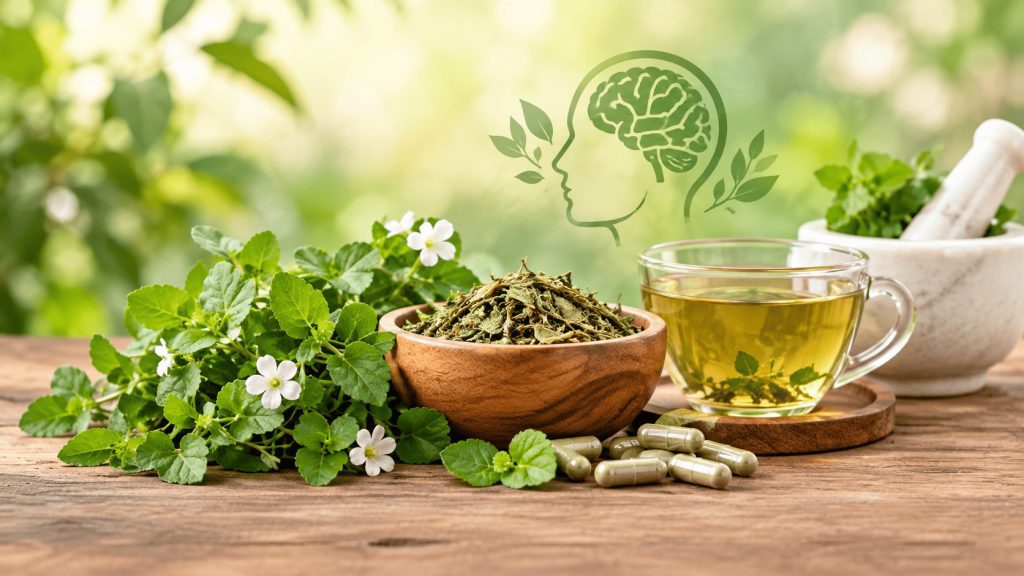
In brief
Brahmi has been used in Ayurvedic medicine for centuries and is commonly associated with memory, learning, mental focus, and calmness. Today, the herb is attracting scientific interest, particularly for its possible effects on cognitive function. Table of Contents What Is Brahmi? Potential…
Brahmi has been used in Ayurvedic medicine for centuries and is commonly associated with memory, learning, mental focus, and calmness. Today, the herb is attracting scientific interest, particularly for its possible effects on cognitive function.
Table of Contents
But how strong is the evidence?
The answer is more nuanced than many supplement advertisements suggest. Human studies indicate that Brahmi may support certain aspects of memory and cognition, particularly after several weeks of regular use. However, studies have used different extracts, doses, and outcome measures, and not all trials have found a meaningful benefit. A systematic review of randomized controlled trials found promising signals for memory but also highlighted limitations in the available evidence.
This article looks at what current research actually says about the potential benefits of Brahmi, where the evidence is strongest, and what remains uncertain.
What Is Brahmi?
Brahmi is most commonly used to refer to Bacopa monnieri, a small creeping herb traditionally used in Ayurveda. It is also known as water hyssop.
One important point is that the name “Brahmi” can sometimes refer to other plants, including Centella asiatica (Gotu kola). Therefore, anyone researching a Brahmi supplement should check the botanical name on the label.
Research on Bacopa monnieri has focused particularly on compounds called bacosides, which are thought to contribute to some of the plant's biological effects.
Potential Brahmi Benefits
1. May Support Memory
Memory is probably the most extensively studied potential benefit of Brahmi.
A randomized, double-blind, placebo-controlled study involving people with age-associated memory impairment found that a standardized Bacopa monnieri extract taken for 12 weeks improved several measures, including logical memory and paired-associate learning.
Earlier systematic research has also found evidence suggesting that Bacopa may improve aspects of memory, although results have not been completely consistent across studies. A systematic review of six randomized controlled trials noted that the trials generally lasted 12 weeks and used extracts at approximately 300–450 mg per day.
More recent research continues to investigate this possibility. A 2026 network meta-analysis of 29 randomized trials involving 2,107 healthy adults reported benefits for some working-memory and short-term-memory outcomes with Bacopa, although differences in dose and study design mean the findings should be interpreted carefully.
Bottom line: There is reasonable evidence for a potential memory benefit, but Brahmi should not be considered a proven treatment for memory disorders.
2. May Help With Certain Aspects of Cognitive Function
Brahmi's possible effects extend beyond memory.
Researchers have investigated learning, attention, processing speed, executive function, and other measures of cognition. A 2024 systematic review identified 22 clinical trials investigating Bacopa monnieri and reported improvements in several cognitive and psychological outcomes across some studies. However, the review also noted considerable variation in dosage, treatment duration, and study populations.
A separate network meta-analysis of natural extracts in healthy adults found that Bacopa monnieri extract was associated with improved memory compared with placebo in the analyzed studies.
At the same time, not every trial has been positive. For example, a randomized placebo-controlled study of 72 healthy adults taking 450 mg of Brahmi extract daily for 12 weeks found no significant differences between groups on its cognitive measures.
This inconsistency is important: Brahmi may have cognitive benefits, but the size and reliability of those benefits are still being established.
3. May Support Stress and Anxiety Management
Brahmi is traditionally associated with calming effects, and researchers have investigated its potential influence on anxiety and stress.
Some human research suggests that Bacopa may reduce anxiety-related symptoms. However, the evidence is less robust than the popular claims surrounding the herb.
For example, an older systematic review of herbal treatments for anxiety found evidence suggesting anxiolytic activity for Bacopa but concluded that rigorous evidence was limited.
A randomized clinical trial has also investigated a Brahmi-containing Ayurvedic preparation in people with generalized anxiety disorder, but studies involving multi-herb or traditional formulations cannot necessarily tell us how much of an effect comes specifically from Bacopa monnieri.
Bottom line: Brahmi may have calming or stress-related effects, but more high-quality research is needed before it can be considered an established treatment for anxiety.
4. May Have Neuroprotective Properties
Laboratory and animal studies have generated interest in Brahmi's possible antioxidant, anti-inflammatory, and neuroprotective effects.
A 2024 systematic review discussed several possible biological mechanisms, including effects involving oxidative stress, inflammation, neuronal function, and synaptic processes.
However, laboratory findings should not automatically be interpreted as proof that taking Brahmi prevents neurological disease in humans.
This distinction is especially important when discussing conditions such as Alzheimer's disease. A systematic review of randomized trials in people with Alzheimer's disease or related mild cognitive impairment found very-low-certainty evidence and no clear difference between Bacopa and placebo or donepezil.
So while neuroprotective mechanisms are scientifically interesting, Brahmi has not been established as a treatment for Alzheimer's disease or other neurodegenerative disorders.
How Long Does Brahmi Take to Work?
Brahmi is not generally studied as an instant cognitive enhancer.
Many of the better-known human trials have evaluated supplementation for approximately 12 weeks.
That means someone taking Brahmi for cognitive support should not necessarily expect an immediate change in memory or concentration after a single dose.
Research on acute effects does exist, but the evidence for longer-term supplementation is more relevant to the traditional claims surrounding memory and learning.
What Dose of Brahmi Has Been Studied?
There is no single universally established dose for every Brahmi product because extracts can differ substantially in concentration and standardization.
Clinical studies have commonly investigated standardized extracts in the range of approximately 300–450 mg per day, although other trials have used different preparations and doses.
The important point is that milligrams alone do not tell the whole story. A 300 mg standardized extract is not necessarily equivalent to 300 mg of raw Brahmi powder.
Consumers should therefore look for the botanical name, extract information, and standardization details rather than choosing a product solely based on the number of milligrams.
Brahmi Side Effects and Safety
Brahmi appears to be reasonably well tolerated in many short-term clinical studies, but “natural” does not mean “risk-free.”
Reported side effects are generally mild and may include:
- Nausea
- Abdominal discomfort or cramps
- Increased bowel movements or diarrhea
- Flatulence
- Dry mouth
- Headache
- Dizziness
The NCBI's LiverTox database reports that Bacopa has not been linked to clinically apparent acute liver injury and describes most reported adverse effects as minor and short-lived.
However, research on long-term use is more limited than research on short-term supplementation.
People who take prescription medications, are pregnant or breastfeeding, have an existing medical condition, or are considering Brahmi for a child should discuss its use with a qualified healthcare professional.
Is Brahmi Proven to Improve Memory?
Not exactly.
The evidence is promising but not definitive.
Several randomized trials and systematic reviews suggest that Bacopa may improve particular aspects of memory, especially after several weeks of supplementation.
However, other well-designed studies have failed to find significant improvements across cognitive tests, and research quality varies.
There is an important difference between saying “research suggests Brahmi may improve certain memory measures” and saying “Brahmi is proven to improve memory.” The first statement reflects the evidence more accurately.
Brahmi vs. Traditional Claims
Ayurvedic tradition has associated Brahmi with memory, intellect, calmness, and mental well-being for centuries. Modern research provides some support for particular cognitive effects, but it does not validate every traditional or commercial claim.
In particular, there is currently insufficient evidence to claim that Brahmi:
- Prevents Alzheimer's disease
- Cures dementia
- Dramatically increases intelligence
- Permanently improves memory
- Replaces treatment for anxiety or other medical conditions
The strongest evidence is better described as potential support for certain cognitive and memory functions, rather than a cure or guaranteed brain enhancer.
What Does the Research Really Say?
Overall, the research paints a cautiously positive picture.
| Potential benefit | What the research suggests |
|---|---|
| Memory | Promising evidence, particularly for some memory measures |
| Learning | Potential benefit, but results vary |
| Attention | Mixed evidence |
| Stress/anxiety | Some promising evidence, but limited |
| Neuroprotection | Strong laboratory interest; human evidence is limited |
| Alzheimer's disease | Insufficient evidence for treatment |
| Safety | Generally well tolerated in short-term studies |
A key issue is study heterogeneity. Researchers have used different Bacopa extracts, doses, treatment periods, participants, and cognitive tests. This makes it difficult to translate the results into one simple recommendation.
Frequently Asked Questions
What is Brahmi best known for?
Brahmi (Bacopa monnieri) is best known for its traditional use in supporting memory, learning, mental focus, and calmness. Modern research has primarily investigated its potential effects on cognition and memory.
Does Brahmi improve memory?
Some clinical trials suggest that standardized Bacopa extracts can improve certain aspects of memory after several weeks of supplementation. However, results are not uniform, so more research is needed.
How long does Brahmi take to show benefits?
Many clinical studies have assessed Brahmi after around 12 weeks of regular supplementation. It should not necessarily be expected to produce immediate cognitive changes.
Is Brahmi safe?
Short-term studies generally suggest that Brahmi is well tolerated, with gastrointestinal symptoms among the more commonly reported side effects. Long-term safety is less well established.
Can Brahmi treat Alzheimer's disease?
There is currently insufficient high-quality evidence to recommend Brahmi as a treatment for Alzheimer's disease. A systematic review found very-low-certainty evidence and no clear advantage over placebo or donepezil.
Is Brahmi the same as Gotu Kola?
Not necessarily. Bacopa monnieri is commonly called Brahmi, but the name Brahmi is sometimes also applied to Centella asiatica (Gotu Kola). Checking the botanical name can help avoid confusion.

Further reading